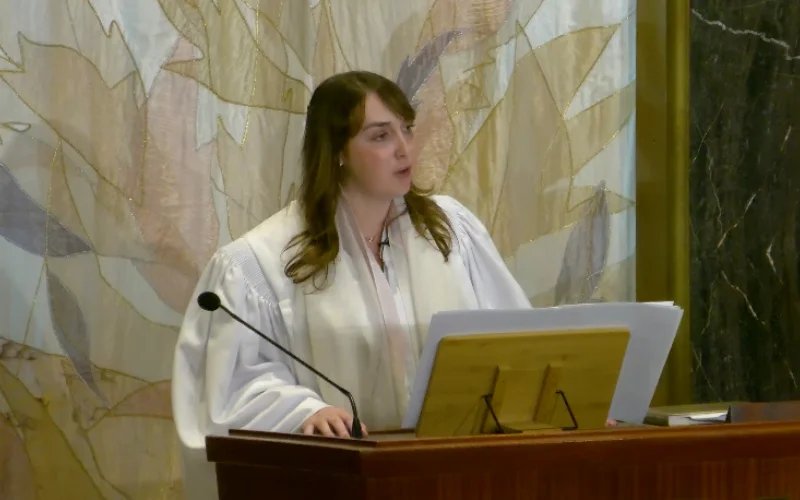
WATCH: Rabbi Rubin's Sermon on Erev Rosh Hashanah & Erev Shabbat 2026-5787

Na'aseh V'Nishma: Renewing the American Covenant
Sermon by Rabbi Jill Rubin on Erev Rosh Hashanah and Erev Shabbat
September 11, 2026 / 1 Tishrei 5787
To view the entire service, click HERE.
Sermon Text
In 1903, Emma Lazarus's poem, The New Colossus was engraved on the Statue of Liberty's pedestal.
Every immigrant who entered this country through New York's ports was welcomed not only by Lady Liberty, but also by the words of a young Jewish woman.
Not like the brazen giant of Greek fame,
With conquering limbs astride from land to land;
Here at our sea-washed, sunset gates shall stand
A mighty woman with a torch, whose flame
Is the imprisoned lightning, and her name
Mother of Exiles. From her beacon-hand
Glows world-wide welcome; her mild eyes command
The air-bridged harbor that twin cities frame.
“Keep, ancient lands, your storied pomp!” cries she
With silent lips. “Give me your tired, your poor,
Your huddled masses yearning to breathe free,
The wretched refuse of your teeming shore.
Send these, the homeless, tempest-tost to me,
I lift my lamp beside the golden door!”
Through her description of Lady Liberty, the 34-year old Lazarus highlights what is most magnificent, most exceptional, about the ideals of our nation.
At her very best, America is the Mother of Exiles, greeting those who have been banished from their home countries with a warm, maternal embrace.
She offers a “world-wide welcome” to those on the outskirts of society: your tired, your poor, your huddled masses yearning to breathe free.
She offers freedoms that most newcomers never could have imagined - freedom of speech, religion, assembly, press.
And she offers opportunity, the chance to walk through a “golden door” for those who have always had the doors slammed in their faces.
She represents the promise of America, a promise still worth fighting for today.
My grandparents, Norman Wulfsohn and Shirley Blecher, arrived in America in the 1960s, believing wholeheartedly in this American promise.
They were born and raised in Johannesburg, in Jewish South African families that had immigrated from Eastern Europe fleeing antisemitism and pogroms.
Because they were white, my grandparents were not subject to the racist segregationist policies of South Africa’s apartheid government, but as Jews they experienced antisemitism. Growing up, I heard stories of neighborhood kids throwing eggs at them and calling them “dirty Jew.”
At the same time, my great uncle was a law school classmate of Nelson Mandela’s, and when Mandela was ordered to leave the restaurant where they were having lunch one day, my great-uncle, as a white man, was allowed to stay.
I carry both parts of that history with me - their experience of being Jewish and vulnerable was real, and so was the privilege they experienced as white South Africans.
In 1965, amid growing political turmoil, my grandparents left the country with my 2-year old mom in tow. Their finances were frozen, They had to start over and leave the rest of their family behind. But, for greater career opportunities and freedom as Jews, it was worth it to come to the United States of America.
They settled in San Antonio, Texas, and did everything they could to fit in in this promised land: they proudly drove their Ford Model T around town,took disco lessons as a family, learned to ride horses, picked up the confusing rules of American football, and became devoted San Antonio Spurs fans. (Don’t worry, I still rooted for the Knicks in the finals.)
They marveled that in the US, one could be both proudly Jewish and proudly American, that this country promised its citizens protection for their freedom of religion and protection against authoritarianism.
Of course they knew that it was an imperfect country with an imperfect past, and I acknowledge that my family’s experience was not equally available to everyone, but they believed in what this country could be at its very best - a multi-ethnic nation that welcomed the stranger and offered opportunities for personal success, regardless of race, religion, or gender.
As we celebrated 250 years of our nation this past July, I thought a lot about my grandparents, may their memories be a blessing. How they had given up so much to come here, how they took a chance to live in a nation where they knew almost noone, and how they believed in the American promise in a way that I sometimes struggle to today.
In today’s America, we see rising levels of antisemitism and fear about Jewish safety; threats to the democratic norms that our country is known for; and violence against immigrants and other vulnerable communities.
We see panic, fatigue, ambivalence.
I know that many of us in this sanctuary tonight have wondered if the Golden Age of American Jews has come to an end, as Franklin Foer suggested two years ago in his widespread Atlantic thought-piece.
America was once the goldena medina, the Promised Land, for so many Jews, including my own grandparents. But today, I wonder - is the Promised Land of my grandparents also the Promised Land for me?
It’s scary to voice this question, but Rosh Hashanah, the start of the new Jewish year, is the exact right time to address it.
On this holy day we renew our covenant with God, returning to our relationship with the divine. We are reminded that God is obligated to us as Jews, and we in turn, are obligated to God and the larger Jewish people.
So, what if we viewed our relationship with this country as a covenant, as well?
My grandparents came here with a very clear question: What can this country provide us?
But a covenant also asks a second question: what can I give in return?
In Hebrew, the word for covenant is brit. At Sinai, amidst thunder, fire, and the blaring sound of the shofar, the Israelites entered into their brit with God.
“Na’aseh v’nishmah,” they said, "we will do and we will listen.”
Why do they first agree to act before they listen?
Our sages understand these words as a commitment not only to act on the covenant in the present, but to remain in relationship with God in the future, even when they don’t yet know what the future will demand of them.
And we know that relationship was never perfect.
The Israelites broke the brit, argued with God and failed to live up to their obligations. But they returned to the relationship, again and again, and God took them back.
Because a covenant does not mean that either side will always get it right. It means that when the relationship is broken, we have an obligation to repair it. It just takes some work.
That is what it means to be in covenant with America.
It’s the conviction that our country is obligated to us as its citizens, to protect our freedoms and our ability to live fully as Jews.
And that we are obligated to our country: to participate in its democracy, to care for our fellow citizens, and to work to make the promise of America not just a dream, but a reality.
That promise is even embodied in the Hebrew name for the United States: artzot ha-brit - the lands of the covenant.
This is no coincidence; the creators of modern Hebrew well understood that we, American Jews, have a relationship of mutual responsibility with this country. Our destinies are bound together.
We don’t owe America blind loyalty; we owe it our engagement, our accountability and our commitment to repair what is broken because the promise of Emma Lazarus’s poem is well worth fighting for.
My grandparents’ America may not be the America we experience today. But perhaps that is precisely what na’aseh v’nishma asks of us: to remain committed to the relationship even if, and especially if, it does not live up to our expectations, and do the work of renewal.
It’s not lost on any of us that 25 years ago, on this day, we were also thinking about what it meant to be part of the American people, what it meant to live in the space between our ideals and our reality.
On September 11, 2001, our country and our city experienced an unimaginable rupture. We wondered if our country could protect us, and the city we once thought was invincible suddenly felt vulnerable.
And yet in the aftermath of the terror attacks, we turned to one another. Strangers helped strangers. People opened their hearts and their homes. First responders and volunteers ran toward danger. Congregations like this one were filled with people who gathered together to mourn.
New Yorkers who had never spoken to one another suddenly recognized each other as fellow citizens carrying the same loss. We saw what the American covenant could be at its strongest: the deeply held belief that another’s suffering was ours, as well.
But that coming together was not the whole story.
The same rupture that brought us together also exposed how quickly we could turn on one another. Muslim, Arab, Sikh, and South Asian Americans experienced discrimination, harassment, and violence. Thousands of American troops were sent to war under false pretenses. In our fear, we sometimes failed to extend to our fellow Americans the same sense of belonging that we were asking them to extend to us.
Maybe this is exactly what it means to live in covenant. It’s not a promise that we won’t fail one another. Instead, it’s an understanding that when we do, we take responsibility and begin the work of repair.
And, perhaps most importantly for us as American Jews, we did not see ourselves as separate from the American people after 9/11. We experienced the same heartbreak, pain, and ultimately, hope for the future as our fellow citizens.
25 years later, as we celebrate America’s 250th birthday, and welcome a new Jewish year,it’s time to say na’aseh v’nishmah once again. We know that our covenant with America is not passive. It asks something of us.
So, what can we do?
First, we can hold our country accountable to its promises. We can demand that our politicians listen to us and protect us, that they hear our concerns about safety and our dreams about the future, just as many of our congregants have done in our work with Metro IAF.
We can insist on our country’s founding principle of freedom of religion - that we be able to live unapologetically Jewish lives in public, showing our fellow citizens that being Jewish and American are not mutually exclusive identities.
Second, we can commit to civic engagement. As Jews who know that democratic norms keep us safe and cannot be taken for granted, we must work towards a stronger democracy.
We can fight against extremism and oppose dictators. We can vote in every election, serve as poll monitors, and write postcards with the Shaaray Justice Team, encouraging our fellow Americans to stay informed and vote as well.
We can reflect on our most cherished institutions in this nation - Head Start, PBS, public schools, to name a few - and do everything we can to strengthen them.
And finally, while we defend and protect ourselves, we can also widen our circle of responsibility and see ourselves as part of the broader American people.
We can think about our own family’s immigration stories, and the Torah’s repeated command to protect and love the stranger. We can get proximate to people whose experiences and hardships differ from our own, and stand up for those whose rights and families are under threat.
Because as Elie Wiesel said as he accepted the Nobel Peace Prize in 1986, “indifference is the most insidious danger of all.”1
The demise of the golden age of American Jewry is a frightening prospect.
But it’s up to us to decide what role we play in the fight to redeem America and her Jewish people: we must do the work of renewal and not allow ourselves to become indifferent; we must look out for ourselves and our fellow citizens, reminding ourselves that we are both Jews and Americans, committed to our country’s tenets of democracy, freedom, and equality.
We have the chance to make our voices heard.
Over 60 years ago my grandparents arrived in this country, looking for opportunity, stability, and the promise of a better life as Jews.
America welcomed them, and gave them lives they could never have dreamed of in South Africa. In return, they were committed to the promise of the United States, to what our country could look like at its very best.
I don’t know if I can look at America with the same uncomplicated faith that my grandparents did. But maybe I don’t have to.
Our tradition teaches us that sacred relationships are not sustained by perfection; they are sustained by commitment and by the belief that the promise of the relationship is worth fighting for.
The work of renewal is the work of a lifetime. There’s no better time to start than now.
Shanah Tovah Tikateivu - Wishing us all a year of goodness, resolve, and strength for the journey ahead in 5787 and the next 250 years of our country’s history.
_______________________________________