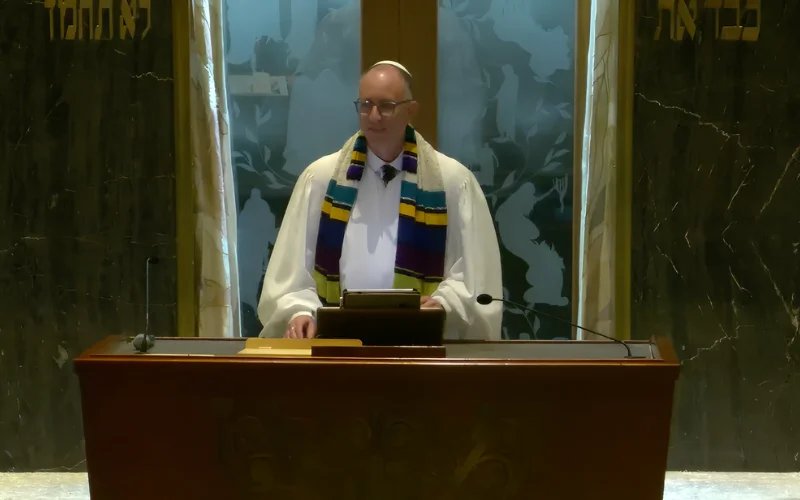
WATCH: Rabbi Mosbacher's Sermon on Rosh Hashanah & Shabbat 5787

A Blank Page and a New Pen
Sermon by Rabbi Joel Mosbacher on Rosh Hashanah
September 12, 2026 / 1 Tishrei 5787
To view the entire service, click HERE.
Sermon Text:
A few months ago, my children and I became citizens of Germany.
There is, of course, something deeply complicated about that sentence. Germany was never my home. I have no plans to move there. Germany was the country that declared that, after 500 years, my family did not belong there. It was the country my grandparents were forced to flee.
German citizenship for me and my kids cannot repair the past. It cannot restore what was stolen, or return those who were murdered. But for me, it opened a door into that past.
Reclaiming the citizenship once taken from our family sent me back into their story as I try to think about how to live now, and finally pushed me to translate more than 70 letters in German my grandfather wrote to my grandmother as their world was coming apart.
I expected the letters to teach me more about how my grandfather had escaped Nazi Germany. Instead, they introduced me to a version of him I had never known.
I knew that in October 1938, at eighteen years old, two weeks before Kristallnacht, my grandfather Henry and his cousin Kurt had fled Germany and all of their relatives to an American Jewish Joint Distribution Committee farm in Holland. The farm was training young Jewish refugees in agriculture, hoping those skills might help them emigrate onward.
And it was from there that Henry began to write letters to his girlfriend Alice, Alice, who would remain trapped in Germany for six more months. She finally escaped to London in April 1939 on a Kindertransport, only a few months before she would have been too old to qualify.
Alice’s letters to Henry are sadly lost, so what remains is only his side of the conversation.
The letters read almost like one of those “travel by map” movies, carrying us across the refugees’ journey. Henry writes to her first from Holland to Germany, and then from Holland to London, then from New York to London. And eventually, from New York to Chicago.
Their lives kept changing time zones. Their words kept crossing oceans with U-Boats patrolling.
But here is what surprised me most: the mundane nature of most of his letters. He writes about the forty cows, fourteen horses and three hundred pigs on the farm in Holland. He writes about sugar beets, table tennis, English and Spanish lessons. He apologizes for forgetting Alice’s birthday. He worries she might meet and fall in love with an Englishman. And again and again, he impatiently asks her: “Why haven’t I heard from you in the last few days?”
From his vantage point, he was not living history, of course; he was living Tuesday.
I had known my grandfather Henry, who I called Opi, as someone whose story had already unfolded. They escaped. They married. They built a life. They raised a family. I knew how the story ended.
But of course, back in 1938 and ’39 and 1940 and ’41, as he’s writing these letters, Henry could not know all of that. He did not know whether they would get to safety, whether they would reunite, or whether they would end up in England, Chile, China, Australia, Uruguay, or the United States. He wondered and worried and wrote, increasingly desperate.
For a moment, Cuba seemed to be the answer when he and Kurt got visas and tickets on a ship. Then, on the trip just before the one that Henry had a ticket on, the ocean liner called the St. Louis was turned away. Cuba closed its doors. And another imagined future vanished.
“Who knows where we’ll end up?” he wrote to Alice. “Anything is possible.”
Henry was not yet my ancestor. He was still becoming himself.
My friends, I know that many families here carry stories of astonishing escape and horrifying loss: the visa that arrived or didn’t, the border that stayed open or didn’t, the train that was caught or missed.
The question is not why Henry and Alice survived when others did not. There is no answer to that question that will satisfy.
The question these letters allow me to ask on this day of the New Year is this: When another page was given to them, what did they choose to write on it?
One answer came in a letter Henry wrote to Alice as Rosh Hashanah approached in September 1940. He had reached New York only a few months earlier. Europe was at war. Members of their families were scattered across continents; there were so many family members and friends who had gone silent. And Alice was still far away in London.
And he wrote to her:
“The past year has brought much suffering to the Jewish people of the world, as thousands of innocents have lost their lives, and many more are in great distress.
“Despite all this,” he writes, “we, who had the great fortune to be able to enter a free country this past year, must remain confident.
“We must look to the future, and continue our lives, and pray for the lives of Jews everywhere.
“In this spirit,” he finishes, I yearn for a shanah tovah tikateivu.”
Eighty-six years later, reading those words with tears in my eyes, I kept returning to one word: Continue.
Not erase or forget. Not pretend that nothing happened. Continue our lives while carrying all the joys and sorrows that had already unfolded.
My friends, Rosh Hashanah in 5787 does not guarantee us a brighter future, either. But it does return our unfinished lives to our awareness, and offers us the opportunity to write a new chapter.
We arrive here in our sanctuary each year carrying what is beautiful and what is broken in our past; the choices we are proud of and those we regret; the brokenness we cannot repair and the possibilities that remain.
Of course, I wish I could go back to the past and try to change it. If I could, I would want to meet my grandfather at eighteen years old, not yet Opi, still frightened, still hopeful. I would want to ask what he imagined for his future. I would tell him what he could not yet know. I would want to say: You will find her again. You will build a life. And one day, your grandson will read your letters.
But even if I could go back, I could not change what happened. I could not give him certainty about the future; he had to live it for himself.
Judaism calls the work of these high holidays teshuvah. We often translate teshuvah as repentance, but the root of the word really means return.
Teshuvah is not magical time travel; it cannot return us to some purer state when we were innocent, untouched, or had not yet made mistakes. It does not enable us to revise the past either.
But it does invite us to review our journeys honestly, and then return to the unfolding life that is still in front of us with more honesty, more courage, and more willingness to choose life and blessing as we move forward.
We cannot change what has happened to us; we cannot change what we’ve done. Some losses remain losses. Some words cannot be unsaid.
But we can still choose what we do next.
When Henry reached New York, he found work almost immediately as a cabinetmaker. He became increasingly skilled; he earned raises, and took night classes. He made friends. He saw Gone with the Wind at the United Palace on 175th Street. He saw Joe DiMaggio play for the Yankees, and he began to feel at home. He wrote about it all to Alice.
And then, nearly three years since they had parted ways in Darmstadt, Germany, not knowing whether they’d ever see each other again, Alice arrived at Hoboken terminal. They spent two romantic weeks together in New York before Alice continued on to her family, who had made their way to Chicago. Henry’s mother had made it to Uruguay and wouldn’t arrive to the United States for more than two years.
Now, Henry had to ask himself, “what kind of American life will we build, and where?”
Henry wrote to Alice:
“I will soon be faced with a big question:
“Should I give up my good position that I’ve established for myself in the short time I’ve been here?”
In the letters, Henry begs Alice to return to New York. She could find work here, he told her. They could build a good life here. He worried that Alice’s relatives were influencing her against him. He feared losing her.
He is alternately loving, frightened, jealous, hopeful, and, at times, more than a little controlling. He wanted her to come back to him.
In other words, he was human, still only 21 years old, doing the best he could with all that he knew.
We, too, are often quite willing for things to change in our lives, provided someone else is the one who actually has to change.
Henry knew what he might lose. He could lose his girlfriend after all they’d been through together and apart. Or, he could lose his work, his community, his proven competence, his sense of security in New York.
He could not yet know what his choice would make possible.
But eventually, he made it. He gave up the position he had worked to establish, and the apartment in the Heights where so many German refugees had settled. He headed for the Midwest. He chose the uncertain life he and Alice might build together over the life he had already begun building alone.
And only from where I stand can I see what was hidden inside that decision: a marriage, a family, decades of mundane life and extraordinary life, 60 years of futility as a White Sox fan, children and grandchildren and great-grandchildren.
But none of that was known by or foreseeable to my Opi.
None of it was visible to him as he hugged Alice goodbye in 1938, or as he stood in the slop of a field of pigs north of Amsterdam that November, or as he contacted every consulate in Holland looking for a way out, as he rode the S.S. Veendam across the Atlantic, or as he wrote letter after letter after letter.
All Opi could do was to continue to choose what he would do that day, and then the next, and choose what attitude he would take about what was beyond his control.
That is what the Torah portion we’ll read on Yom Kippur means when it commands us to choose life. Not to know the future or to guarantee the outcome. Not to erase the past. But to choose with intention the next action we will take.
Those 70 letters carried the journeys of my grandparents Henry and Alice across borders, oceans, languages, and years of separation. Then, as they moved toward reunion, the letters stopped.
Not because the story ended. But because the distance between them did.
Henry and Alice were still becoming themselves. And, without knowing it, they were also becoming my ancestors.
Every ancestor was once a person standing inside an unfinished life, making choices without knowing who might one day inherit them.
And that is exactly what you and I are doing right now, in these ten days of return. We are becoming ancestors.
Not only those of us who have children or grandchildren. We become ancestors through every life we touch or ignore, every person we make room for or reject, every institution we strengthen or neglect, every wound we interrupt or inflict on another person.
And most of the choices through which we become ancestors will not feel historic while we are making them. They will feel like Tuesday. They will be ordinary conversations at the kitchen table. They will be apologies or not. They’ll be “do I make the same mistake this time, or do I risk making new mistakes?” kinds of choices.
We are never merely writing a personal sacred story when we make these choices; we are setting the conditions for the future of those who will come after us.
So what choice are you willing to make this year so that the next pages of your life offer more of who you want to be, and more of what this world and your descendants need you to be?
Opi’s letters stopped the moment he boarded a Greyhound bus to Chicago.
The next fifty years of Alice’s life, and the more than sixty years of Henry’s, are not contained in letters. From inside their correspondence from 1938 to 1941, all of that life remains unwritten.
The letters stop. But their lives did not.
They did find each other again. They built a life. Their choices became family history. And I am one of the people standing inside the consequences of decisions that they could not possibly foresee.
Henry could not know as he got on that bus who would one day inherit the life he and Alice were choosing. And neither can we.
That is why Rosh Hashanah is so important.
This day, this season, does not erase or whitewash the pages we’ve already written. It reminds us that today is a new day, a new chance, a new choice.
Rosh Hashanah offers us grace as well, so that we do not become so hard on our past selves that we stop believing we can do better.
So what will we write on the next precious piece of paper we have been given?
We could apologize. We could approach other people with greater tenderness. We could choose to let go of a fear that has held us back. We could finally begin a new chapter.
And we could do all of that even knowing that we cannot rewrite everything we’ve already written in our Book of Life, but that we still have the opportunity to write what comes next.
Eighty-six years ago, my grandfather wrote one word into the prayer in his Rosh Hashanah letter to my grandmother: Continue.
Continue with honesty. Continue with courage, with greater intention. Continue differently when we can, and when we must.
May we have the courage to face the past without becoming trapped there, the humility to admit what we cannot control, and the faith to choose life.
May we make the choices that allow us to offer more of ourselves to the people we love, and to those who will read the pages of our lives long after we’re gone.
The next blank page and a new pen are right here, in our hands.
“Who knows where we’ll end up?”
“Anything is possible.”
Shana tova tikateivu.