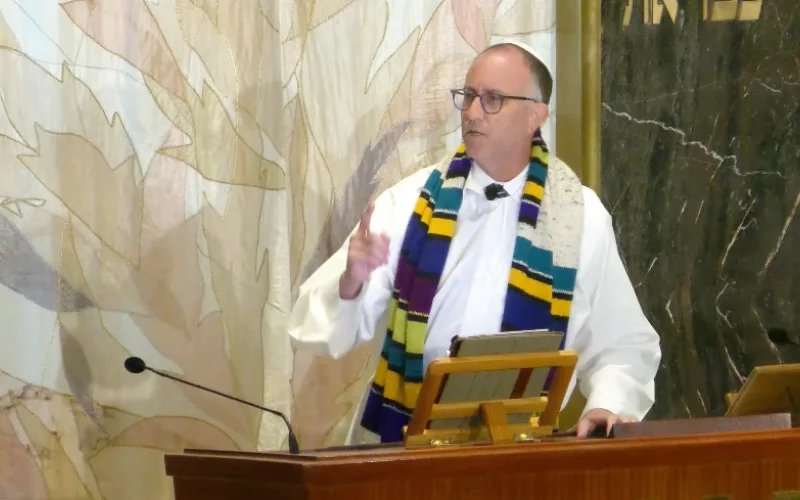
WATCH: Rabbi Mosbacher's Semon on Yom Kippur Day 2026-5787

Fear and Covenant
Semon by Rabbi Joel Mosbacher on Yom Kippur
September 21, 2026 / 10 Tishrei 5787
To view the entire service, click HERE.
Semon Text
Over the past several years, I have sat in conversation with hundreds of members of our congregation: in my office, after services, in hospital rooms, across kitchen tables, over coffee, tea, bourbon. And more of those conversations than I can count have been about fear.
If you have watched the rise in antisemitism with fear, so have I. If you worry about the future of Jews in America, I worry, too, although a little less after Rabbi Rubin’s incredible sermon on Erev Rosh Hashanah. If you’ve lain awake anxious about the future of the land and people of Israel, so have I.
I don’t stand before you today holding less fear than you. I stand here because I believe that Judaism has something to teach a frightened people.
Judaism doesn’t teach us not to be afraid; that would be naive after all we have been through. Instead, it teaches that when we are afraid, we can find strength if we hold on to one another.
Of course, fear can be a necessary teacher. It alerts us to danger and reminds us what we need to protect. But Yom Kippur asks: What has our fear permitted us to become?
That is the work of cheshbon hanefesh, the accounting of our souls: to turn from the danger outside of us long enough to ask what fear is doing inside us.
Because fear can make us forget where we’re going.
It can lead us to separate our fellow Jews into mutually exclusive categories: friend or enemy, loyal or disloyal, with us or against us.
Last Yom Kippur, I spoke of my concern about an unfolding Jewish uncivil war, and I pleaded with us not to let disagreement cause us to turn away from one another. I still believe that.
But this past year, I have come to think that there is an even deeper question, and that is: What happens inside us that makes us want to turn away from each other in the first place? Who have I allowed my fear to reduce from a soul to a sound bite?
Before I ask you to wrestle with that question, I need to tell you about two congregants who helped me realize that I needed to wrestle with it myself.
I have felt fear narrowing my own soul, perhaps nowhere more clearly than in conversations about Israel, where some of our deepest fears and fiercest convictions collide.
A few months ago, I sat at Ella’s Café with a member of our congregation. She was upset that the speakers we bring here to talk about Israel rarely represent her perspective, and that she feels as if people with her perspective are too quickly dismissed by me or other congregants as right-wing fanatics or indifferent to Palestinian suffering.
I was listening to her words, but I had already begun sorting her.
I knew what category she belonged in. I knew the arguments I could make in response. And I knew that I knew that she was wrong.
And because I thought I understood which political direction she was facing, I almost missed what the person sitting across from me was longing for: a safe and secure Israel that lives up to its highest ideals.
What she was trying to tell me was that she loved being Jewish, and that Israel was a central part of her Jewish identity.
Then she told me that after her mother died this past year, she had begun going to a different congregation to say Kaddish. Because she felt so judged here, she did not feel comfortable saying Kaddish here.
And suddenly, this was no longer a conversation about Israeli politics. This was a grieving daughter telling her rabbi that she had not felt at home in her own synagogue at precisely the moment when she needed her Jewish community the most.
I apologized to her.
Not because I had changed my mind about my heartbroken love of Israel. I apologized because I realized that I had allowed what I thought I knew about her politics to interfere with my ability to see her as a heartbroken person.
Just a few weeks later, at that same table at Ella’s, another conversation held up the mirror to me from the opposite direction.
A young man who grew up in this congregation came to tell me about his grief and anger over Israel’s actions since October 7, and about how he’d found another Jewish community where he could more freely protest actions he believes are wrong.
And as he talked about the protests, I started listening for his political direction, and I started preparing my stout response.
And I almost missed him, too.
Once again, I apologized.
For what he was trying to tell me was that what he longed for was an Israel that lived up to the highest Jewish ideals we’d taught him about in religious school. And also that in that Jewish protest space, he had found opportunities to study Torah, to celebrate Shabbat, and to connect deeply with other Jews.
He was trying to tell me that he loved being Jewish. And that he was afraid that I, and the congregation that had helped raise him, didn’t even care about that, because all we knew was that he was protesting the actions of the Israeli government.
These were both hard and painful and important conversations.
Two people. Very different convictions. The same rabbi sitting across from them.
And twice, I had made the same mistake.
That is something I need to confess on this Yom Kippur. I had been listening first for positions, for directions. I needed to be listening for souls, for destinations.
One more thing you should know about these two precious people: They are both here at Shaaray Tefila for these High Holidays. Both of them.
After wondering whether this was still a Jewish home where they could bring their whole selves, they came back, at least for now.
Their return doesn’t mean we’ve changed each other’s minds. But it does mean that we’ve each decided that each other and this community and the Jewish people matter as much as our differences do.
Which brings me to east and west.
There is something about the orientation of this holy space that should have taught me this lesson years ago.
When Shaaray Tefila bought this building in 1958, it was a movie theater, a movie theater oriented toward the west. And when it became our sanctuary, it continued to face west, as it does today.
The problem, of course, is that Jews traditionally pray towards Jerusalem, and from New York, the short way around the globe to Jerusalem is about 6,000 miles that way, to the east.
Later, the leaders of our congregation built our beautiful chapel on the second floor. And there, the ark is on the northern wall. And during Covid, we prayed at home facing screens in every imaginable direction.
When my family first moved to the city, I was amazed by New Yorkers’ sense of direction. Someone would say, “Go east for three blocks,” and everyone else seemed to know which way east was. Someone would tell me, “Head toward the river,” and I would think: But there are two rivers.
My friends, New Yorkers know east from west.
And yet, here we are, for the 67th Yom Kippur in this building, praying towards the west, and every Saturday morning at 10:15 towards the north. And yet, it seems to me that whichever direction we pray in, somehow we manage to remain on the same spiritual path as a community.
Because facing in a different direction is not the same as heading away from one another.
Facing west instead of east may be the longer way to Jerusalem. But ours is not a different longing.
I see someone’s orientation, and I assume I know their destination.
I hear what someone believes about Israel, about politics, God, or Judaism and assume I know what they love, what they fear, and where they are going.
But I don’t.
People facing in opposite directions may still be reaching for the same sacred center.
That does not make every direction equally advisable, every argument equally persuasive, or every moral claim equally right.
But before I decide that someone is facing away from everything I hold sacred, I had better ask where they’re trying to go. Because we may in fact be diametrically opposed.
But if we stay with each other past the first impression, we may discover that we are actually trying to reach the same destination.
In a little while in our service, we will confess our sins collectively. In so doing, Yom Kippur does not let us hide behind the worst sins on the list: I haven’t murdered. I haven’t stolen.
Because there are less dramatic ways to diminish another human being.
There are ways of shutting someone out of community that leave no bruise. There are ways of making another person feel that there is no place for them here without ever raising our voice.
And when we confess together, we take responsibility for the community we are creating together.
But sometimes our fear does something dangerous: It allows conviction to become permission. Permission to diminish another person. Permission to close our hearts. Permission to turn away from each other.
And strangely, this can happen precisely when we are most convinced that we are the ones defending something sacred.
The Talmud, in tractate Yoma, tells a terrifying story that helps make this point.
In the ancient Temple in Jerusalem, the priests would compete for the sacred task of removing ashes from the altar. They would race each other up a ramp to see who would receive that honor, and the community would gather to see who won.
One day, two priests were running up the ramp side by side. And as one priest pulled ahead, the other took out a knife and stabbed him in the back.
A priest stabbed another priest. In the Temple. While competing for the privilege of serving God.
And as the dying man lay bleeding, Rabbi Tzadok stood on the Temple steps, turned to the Jews who had gathered to watch, and asked:
“Upon whom does responsibility for this bloodshed fall?”
The Torah teaches that when a murdered person is found and the killer is unknown, the elders of the nearest city perform a ritual acknowledging communal responsibility.
But here, the killer was known. And still, Rabbi Tzadok asked.
Everyone knew who held the knife. Tzadok was asking the community to examine not only the killer, but the culture that had formed him.
What kind of religious community had they created in which the desire to stand for something sacred could make a human life seem disposable?
The story is extreme. But the question is not.
On this Yom Kippur, Rabbi Tzadok’s question becomes intensely personal for us: What have we permitted ourselves to do because we are afraid?
The answer is not to hold our convictions less strongly.
There are convictions worth having, beliefs worth holding onto tightly; moments when Judaism demands that we speak, debate, and argue.
The work of teshuvah is not to loosen our grip on everything we believe. I don’t want the woman I met at Ella’s to care less about Israelis, or the man I met there to care less about Palestinians.
I want us all to have strong backs. To know what we believe, what we love and fear losing, and to be able to bring all of ourselves in all of our complexity to this place.
But that requires us to have open hearts, too.
Not to become less certain of what we each know, but to be less certain that our certainty tells us everything we need to know about another human being.
For years now, I have used the language of strong backs and open hearts from this pulpit.
As I come toward the end of my years as your senior rabbi, I think I understand that phrase differently than I did when I first began using it.
I used to think that the hard part was developing a strong back: knowing what we believe and having the courage to stand for it.
I am less sure of that now.
We live in an age that rewards certainty. It rewards the quick judgment, the quick cancellation, the devastating response, the ability to identify immediately who is right and who is completely unworthy of existing at all.
I am thinking back on Rabbi Rubin’s powerful sermon last year about moving away from “the place where we are right.”
The more countercultural spiritual discipline in this moment is the open heart.
Not weakness. Not indecision.
But curiosity.
The willingness, even when I am certain I know what someone believes, to wonder who they are trying to be, and to wonder whether who they are trying to be is so profoundly different than who I am trying to be that they deserve to be cut off from my life and my community.
Some years ago, during a High Holiday sermon, I invited you to make a fist and press it against your heart, as we do during Ashamu.
If you are willing, I’d invite you to make that fist again now and rest it against your heart.
Feel what your heart carries. Your experience. Your knowledge. Your convictions.
Everything you have learned from the life that only you have lived.
Hold on to all of that.
And now, without removing your hand, let your fingers slowly unfold.
Open your hand. Keep it there.
You have not surrendered your convictions. You have simply changed the way you are holding them.
That is the practice for this Yom Kippur: not weaker convictions, but a different way of holding them.
Strong enough to speak. Open enough to listen.
Strong enough to act. Open enough to remain curious.
Strong enough to say, “I believe you are wrong.” Open enough to wonder, “What more can I learn about your sacred story?”
Keep your hand there for one more moment as I offer this prayer on our behalf:
Ribbono Shel Olam, Master of the Universe,
Do not let fear harden my heart.
Do not let my certainty make another person invisible to me.
Give me the courage of a strong back.
And the humility of an open heart.
Help me notice the moment when conviction becomes permission.
Help me listen for the soul beneath the position.
And when I have failed to see someone clearly, give me the courage to return.
And the grace to receive them when they return to me.
Amen.
After all these years we have shared, my friends, may we keep learning to open the door to one another, to walk alongside each other, to love the complicated, messy, brokenhearted, joyful, longing people all around us with all our hearts, with all our souls, and with everything we have, and may they love us, too.
G’mar chatimah tova.
May we be sealed, all of us, together, for blessing in the Book of Life.