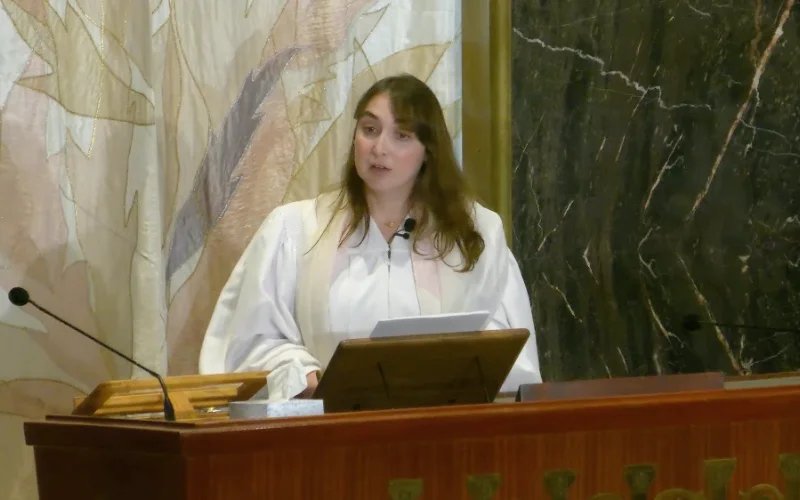
WATCH: Rabbi Rubin's Sermon from Erev Yom Kippur 2026-5787

Becoming Israel
Sermon by Rabbi Jill Rubin for Erev Yom Kippur
September 20, 2026 / 9 Tishrei 5787
To view the entire service, click HERE.
Sermon Text
Two years ago, I stood on this bima on Kol Nidre and spoke to you all about my mental health struggles in the weeks and months after I had my son, Coby. I’m sure you can imagine how relieved I felt when I didn’t experience the same struggles after my daughter, Noa, was born this past January.
Other than an aggressively cold winter, my second maternity leave was turning out to be so much better than my first. Of course I was exhausted, but I was also calm and happy. I didn’t feel like I was drowning. And I was grateful for the precious time with my family that I could not fully appreciate the first time around.
And then, as it often does in life, the other shoe dropped.
Or in this case, a leg.
Just as I was sitting in my gratitude, Coby fell and broke his leg.
And since this wasn’t just a simple break, he went under general anesthesia so the surgeon could fit him with something called a spica cast – which for those of you fortunate enough not to be familiar with these,is a special body cast that immobilizes the entire leg and pelvis.
We spent the night in the PICU learning how to clean him and change his diapers. It was as if we were first time parents again, learning everything from scratch, and suddenly, my maternity leave once again looked very different than I anticipated.
Instead of spending time bonding with my new baby, I was carrying my toddler from room to room, trying to keep him comfortable, hydrated, and clean. I brought him back and forth from the Hospital for Special Surgery, hoping and praying each time that they would tell me the cast could come off, that his leg was healed.
When Coby’s cast finally came off, my usually active toddler didn’t walk for days, afraid of putting any weight on the leg that had caused him so much pain.
And eventually when he did walk, he limped, and even though I cheered him on, it was so hard to watch him struggle.
My son is now fully healed, thank God, but during that time my family experienced a few months of real hardship.
My first maternity leave had not been at all what I expected it to be, and now the second hadn’t either.
But the thing is, you all know this story, because you’ve lived it, too.
Perhaps you didn’t have a child with a broken leg (shoutout to the Osterers and Elkins), but every single one of us in this room has experienced some form of interruption in our lives, some challenge that we didn’t expect or even welcome, and we have all wondered how to move through it, how to keep putting one foot in front of the other instead of retreating inwards, And letting the pain completely overwhelm us.
Tonight, as Yom Kippur begins, we think about our mortality - we fast and refrain from all life-affirming activities as a sort of rehearsal of our death - but in 25 hours when the fast ends, we move forward with our lives. We once again do the things that bring us joy, nourishment, and satisfaction.
Judaism teaches that it’s important for us to sit in the hard places, to remind ourselves that our lives are finite and not completely in our control, but Judaism also teaches that we should not stay in the hard places forever.
Have you ever wondered why we are called the people of Israel?
The name Israel comes from the Hebrew word meaning to struggle or “one who contends with God.” And we receive that name through our ancestor Jacob.
The story in the book of Genesis goes like this:
Jacob is preparing to meet his brother Esau for the first time in years. He’s anxious about what will happen when they see each other again. In the middle of the night he is visited by an ish, a mysterious being, who wrestles with him until dawn.
Jacob perseveres, and once the ish discovers that he cannot defeat Jacob, he wrenches Jacob’s hip out of his socket.
(Yes, having a son named Coby who broke his leg makes this story ring eerily true to me this year.)
The sun begins to rise, and even though Jacob is injured, he continues to fight, refusing to allow this heavenly being to prevail. Finally, the ish surrenders, and begs Jacob to release him.
Famously, Jacob answers, “I will not let you go unless you bless me.”
And it is at this moment that Jacob’s name is changed: “Your name shall no longer be Jacob,” the heavenly being says, “but Israel. For you have striven with divine beings and have endured.” In the conclusion of the short narrative, Jacob limps away, a changed man forever.
We, the Jewish people, are named after this encounter.
We are Yisrael - not because we are spared hardship, but because we are a people who wrestle with what life brings us.
This is not the first time in the Torah that Jacob encounters adversity. Like so many of us, his life takes unexpected twists and turns that impact him deeply. He steals his brother’s birthright and flees his parents’ home. He works for his uncle for 7 years, hoping to marry his beloved Rachel, before he is deceived under the chuppah. And of course, his name is changed to Israel in an encounter with an angel just as he is preparing to reconcile with his brother after many years. In his most anxious moment, he is literally and figuratively hit with a huge blow.
The act of accompanying is one of the most moving parts of my job. Through joy, pain, fear, heartache, and anticipation, you share your life’s biggest moments with me, and I am honored to be witness to them.
And because of this, I know some of what you all have gone through. I know what you have endured. I know how strong you are, and how you have wrestled with God over and over and over.
I know that all of us in this room tonight, and watching on livestream, can see ourselves in our ancestor Jacob’s story. We have all had moments of real pain in our lives. Moments that were unexpected.
That changed how we viewed the world. That taught us that life was not completely in our control. Moments when our hips were wrenched out of their sockets, and even if we prevailed in the moment, we walked away with a limp, forever changed.
Perhaps you unexpectedly lost your job, or a job that you’ve been wanting for a long time didn’t pan out the way you thought it would, and you feel a deep sense of disappointment.
Maybe you’ve been navigating health challenges, or you lost a loved one to an illness, and you feel stuck in the sadness, grief, and fear.
Or maybe a relationship that once felt sacred to you has faltered, and you feel an overwhelming sense of loss.
The challenge for us, like our ancestor Jacob, is to move forward with grace, compassion, and hope. To merit the name Yisrael - to struggle and contend instead of surrendering altogether.
One way we can do this is to share our stories. The good, the bad, and the ugly.
Psychologists sometimes talk about the power of naming the things we go through – putting difficult experiences into words so that we can begin to understand and integrate them.
Our ancestors understood this concept long before modern psychology - they told and retold their stories of sickness, infertility, war, and betrayal over and over.
Not only to create a written record and pass on the lessons they learned from generation to generation, but also to make sense of them.
They grappled with the disappointment and the fear of everyday life, just as we do today, and putting their hardships into words undoubtedly helped them process the challenges they experienced.
So, I share my story with you tonight not because I want sympathy or advice, but because sharing is a way of making sense of the challenges we face, and a way of deeply connecting with one another.
During this intensely difficult time, I was not shy about asking for help or telling people around me how my family was really doing. When someone asked me how I was, I bluntly replied, “not too well.”
And something amazing happened when I was honest with people - instead of running away, everyone leaned in.
They offered more help, they continued to check in, they sent books, toys, and games, and they suggested walks and chats on the phone. Without that support, I don’t know what we would have done.
Our lives are anything but perfect, and yet we, as a society, have such a hard time talking about anything but the perfect things - where we travel, the fun things our kids are up to, our successes at work.
And of course those things are very important to share; as a community, it’s our responsibility, and our joy, to lift each other up and take part in one another’s celebrations and achievements. This is why we share smachot, joyous things, every single Friday night during Shabbat services after we pray for healing for our loved ones.
And, at the same time, I know what some of you are carrying. We do not do ourselves justice when we only talk about the good. We’re all struggling with something. Sometimes, like a broken leg, it’s obvious to the world, and perhaps easier to talk about. Sometimes, it’s not.
This community is meant to be a place where we can bring our entire selves - the joy we are experiencing alongside our grief, pain, and struggles. Because the only way we can move through the struggles is by acknowledging them in the first place.
Like our ancestor Jacob, we become Israel not merely by experiencing interruptions in our lives.We become Israel by wrestling. By contending with the things that are so unfair, and by walking forward anyways, even if we walk with a limp.
When I read Jacob’s story as a child, I always wondered why Jacob’s name change was considered a blessing. Wasn’t a blessing something good, like health, luck, or fortune?
As I’ve now come to understand it, this blessing is an invitation. It’s an opportunity to take what we are given in life, and to use it as a force for connection and love.
It’s an affirmation that struggling does not make us less than.
It’s a declaration that we, the people of Israel, are endlessly resilient, and that we can and should lean on one another to get through the inevitable ups and downs of our unpredictable lives.
Because while our suffering can be just plain awful, the human connection that comes out of it can be a light in the darkness.
So share your stories with your fellow congregants, sit down with our compassionate clergy, seek help from someone that you trust.
Perhaps, in that journey, you will meet someone who is silently struggling with the same illness, or you will find solace with a person who is also caring for a sick family member.
Perhaps you will encounter someone who fully understands some of what you are going through, or you will open your heart to someone who is going through something you never could have imagined.
And maybe, just maybe, you will begin to heal.
I have one more story I’d like to share with you all tonight.
In March of this year, Rabbi Andrea Weiss, one of my teachers and a giant in the Reform Jewish world, died after a year long battle with cancer at the age of 60. She left behind a devastated family and community.
Rabbi Weiss was a trailblazer in so many ways: she edited the first ever Women’s Torah Commentary, she was the first woman to serve as Provost of our seminary, Hebrew Union College, and she was the first woman to ordain rabbis and cantors in the Reform Movement.
She was the one who, in 2022, laid her hands on my head and bestowed upon me the title of rabbi. She was brilliant, compassionate, funny, and strong. She was truly a rabbi’s rabbi.
In March of 2025, after she had started treatment, she wrote the following words in her journal: “This is what I know from my go-to biblical texts. Psalm 126:5 - “Those who sow in tears will reap in joy.”
Psalm 126 speaks to the unadulterated joy that the Israelite people will feel when they return from exile to Zion - their mouths filled with laughter and their tongues with songs of joy. Those who sow in tears shall reap in joy, the psalmist tells us, one who goes along weeping, carrying the seed bag,shall come back with songs of joy, carrying the sheaves.
In an agricultural sense, this verse makes perfect sense - it tells us that someone who weeps while they’re planting seeds will be joyful when they reap the bountiful harvest a few months later. That their tears will be fodder for the soil and help the crops grow.
But when Rabbi Weiss wrote those words in her journal, when she was grappling with her illness and the fear of the unknown before her, I don’t think she was referring to their agricultural meaning. She was referencing these words for their spiritual power.
This biblical verse tells us that weeping and joy often go hand in hand. That showing our sadness and grief to the world is not a weakness, but a strength. That even when there is pain, even when there is interruption, something new and life-affirming can be harvested - beautiful human connection.
Life is anything but easy and straightforward. There will always be hardship. There will always be tears. But we are Yisrael - people who wrestle with God.
We grapple with everything life throws at us, and we find blessing when we do it together.
So in this new year of 5787, may we all harness the strength of our ancestor Jacob, and walk forward in life, even with a limp, knowing that we will confront our hardships together.
G’mar Chatimah Tovah, may you be inscribed for good in the book of life.